

Owen Spolyar and Jack Farrell
A health-benefit analysis of non-exponentially distributed infectious periods of Chlamydia trachomatis
Abstract:
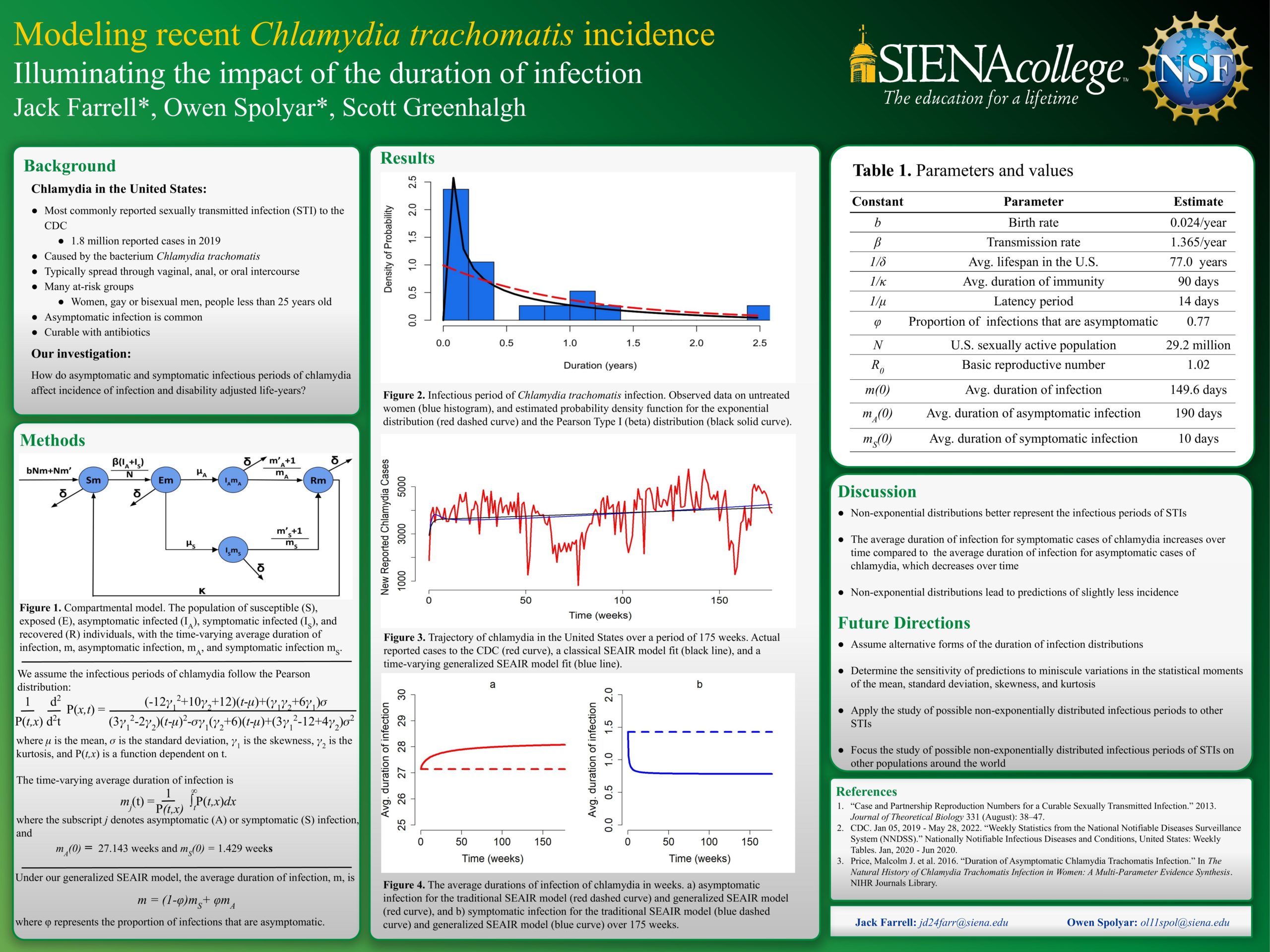
Pandemics devastate the health and economic well-being of society. Consequently, it is imperative to accurately predict impending infectious disease outbreaks and determine effective disease interventions through the use of epidemiological tools, such as compartmental models. Unfortunately, many ODE compartmental models require the assumption of an exponentially distributed infectious period, despite it being well-known that such an assumption is often biologically invalid. This could negatively impact the evaluation of disease interventions, we explore the use of an entirely new family of ODE compartmental models that feature non-exponentially distributed infectious periods. Specifically, we investigate their ability to predict the health-benefit ratio of disease interventions. We apply our model on the trajectory of Chlamydia trachomatis in the United States, and illustrate how variation in the infectious period’s mean, standard deviation, skewness, and excess kurtosis alters predictions of incidence averted and disability adjusted life-years saved over a 5-year horizon.
Title
A health-benefit analysis of non-exponentially distributed infectious periods of Chlamydia trachomatis
Faculty Advisor
Dr. Scott Greenhalgh
Course
Summer Research
Presentation Type
Location
Table 44