

Emily Schafer, Mackenzie J. Perpetua, Natalie C. Stagnitti, Sarah M. Dauphin, Gabrielle L. DeAngelis, Alec P. Brundle
Large Anisotropic Effect Observed in Natural Products from Smilax auriculata
Abstract:
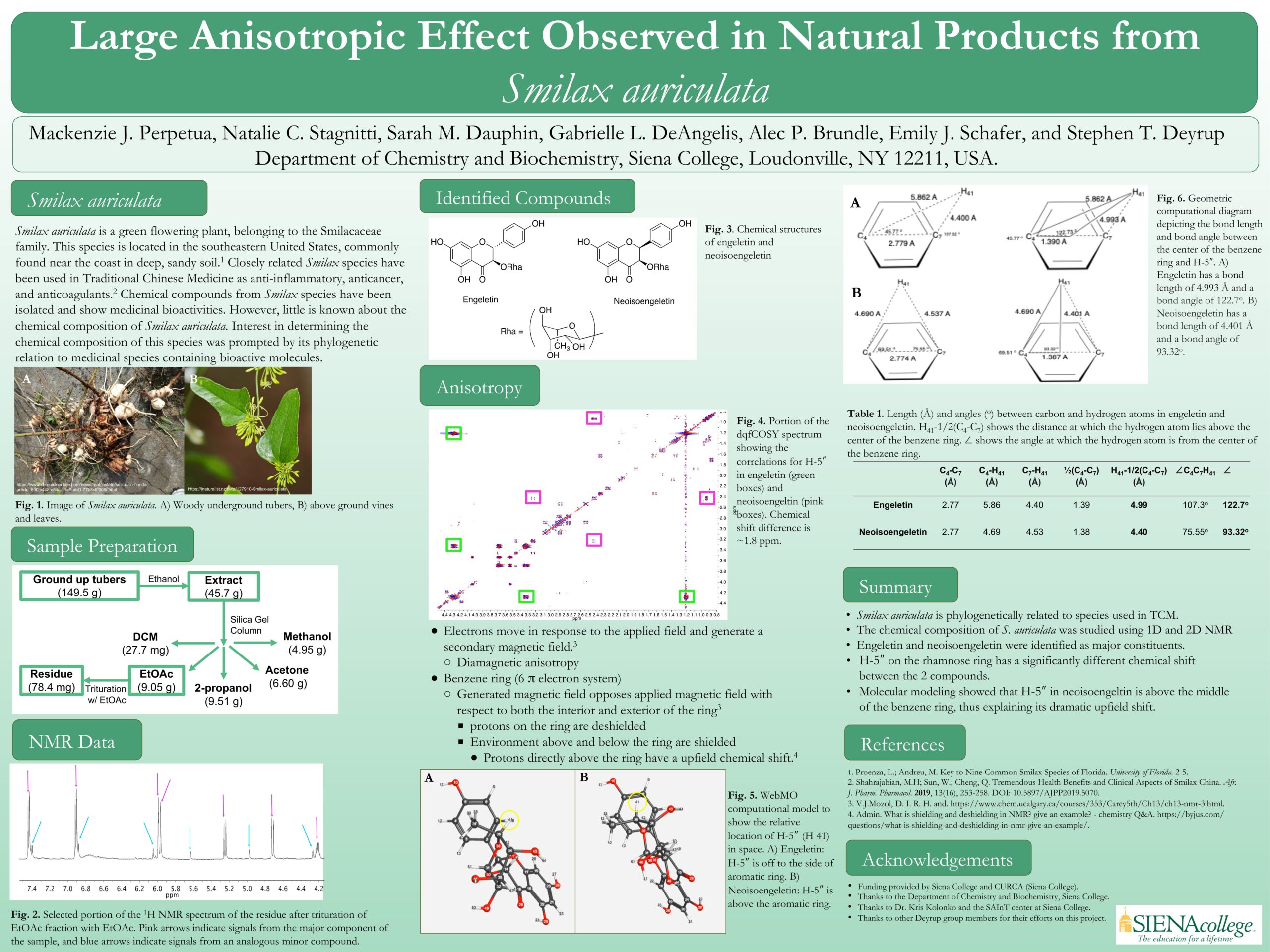
Traditional Chinese Medicine has a long history of using different organisms as materia medica. One of these organisms is the plant Smilax glabra which has been used to treat dysentery and joint pain. We studied the native North American vine Smilax auriculata since it is closely related to S. glabra and little is known about its chemistry. Chemical investigation using 1D and 2D NMR spectroscopy of S. auriculata tubers determined that the major secondary metabolites were flavonoid glycosides. Specifically, engeletin and neoisoengeletin were partially purified and identified. Intriguingly, a large anisotropic effect (Δδ ~1.8 ppm) was observed in these natural diastereomers based on the relative configuration of the rhamnose and aromatic ring moieties. Computational studies supported the idea that H-5′ is positioned closer to the face of the aromatic ring in 2 than in 1.
Title
Large Anisotropic Effect Observed in Natural Products from Smilax auriculata
Faculty Advisor
Dr. Stephen Deyrup
Course
Summer Research
Presentation Type
Location
Table 29