

Savana Goslovich and Cassie Smith
Surprising impacts of dietary fiber on leafcutter ant foraging and colony growth
Abstract:
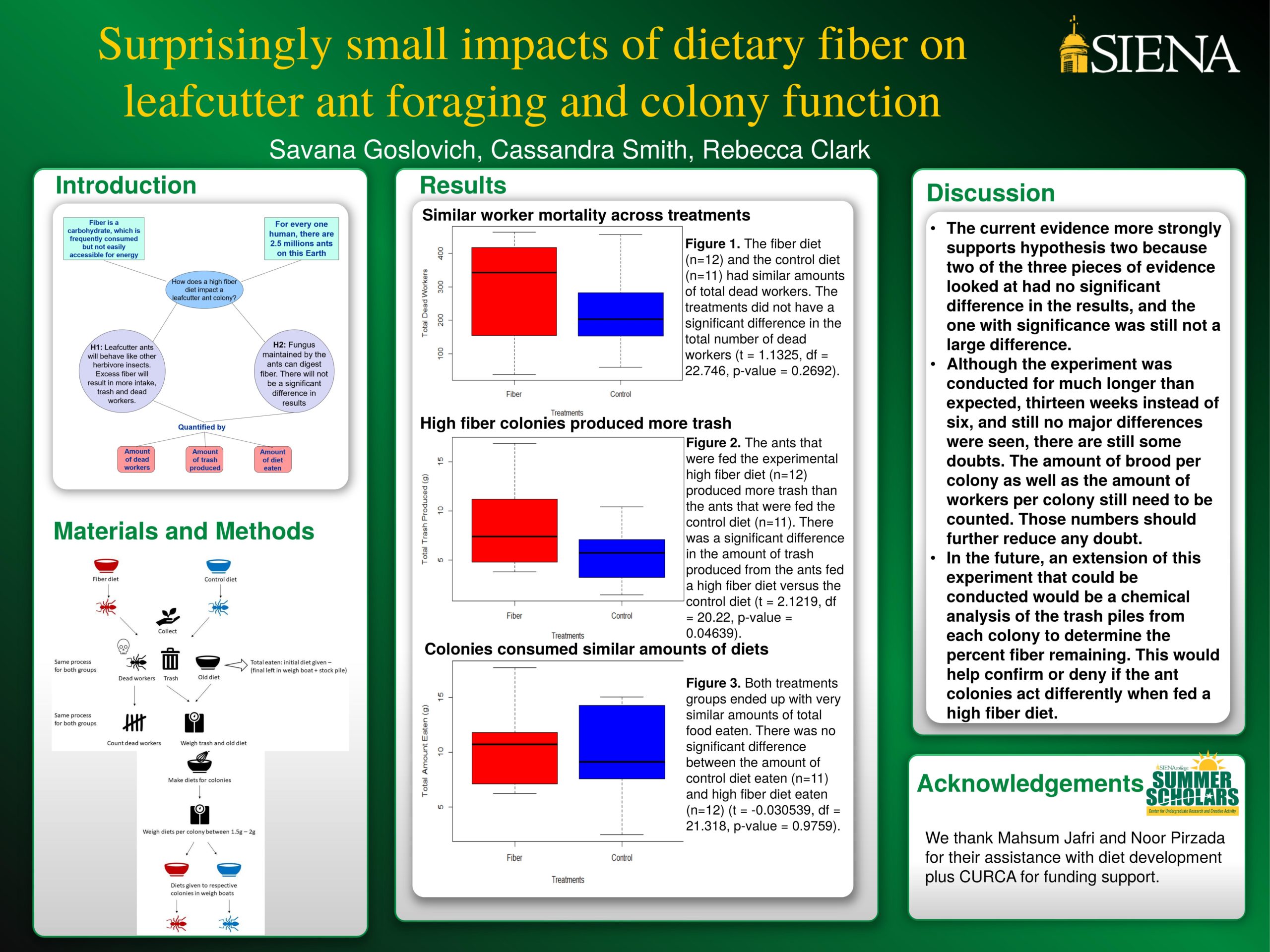
Leafcutter ants have a symbiotic, mutualistic relationship with a fungus garden they maintain and grow. The ants bring leaves to the fungus, which releases enzymes that break down the leaves into nutrients the ants can digest. Fiber consists of carbohydrates which the ants cannot directly digest, but the fungus garden can. We examined colonies of leaf cutter ants (Acromyrmex versicolor) to evaluate the effects of a 50% cellulose fiber diet versus a control cornmeal diet on: food collected, fungus garden growth, waste produced, and the number of ants, dead and alive, across 12 weeks. Although colonies on the 50% fiber diet produced marginally more waste compared to controls, all other measured aspects of colonies remained statistically similar. This was surprising because we expected the high-fiber diet to be difficult for colonies to digest because it contains fewer simple sugars; most herbivorous insects increase food intake in response to high fiber. Even though the ants lack cellulose digestive enzymes, that does not appear to stop them from giving fiber to the fungus, which appears able to readily digest it. There remains much hidden communication between these organisms that we have yet to discover. The current results give more insight into how deeply these two symbiotic partners interact, and the nutritional benefits of this mutualism, even though the ants cannot use the high fiber diet themselves.
Title
Surprising impacts of dietary fiber on leafcutter ant foraging and colony growth
Faculty Advisor
Dr. Rebecca Clark
Course
Summer Research
Presentation Type
Location
Table 53