

Julia Mertikas
The Effect of Emotion Regulation of Financial Analysis
Abstract:
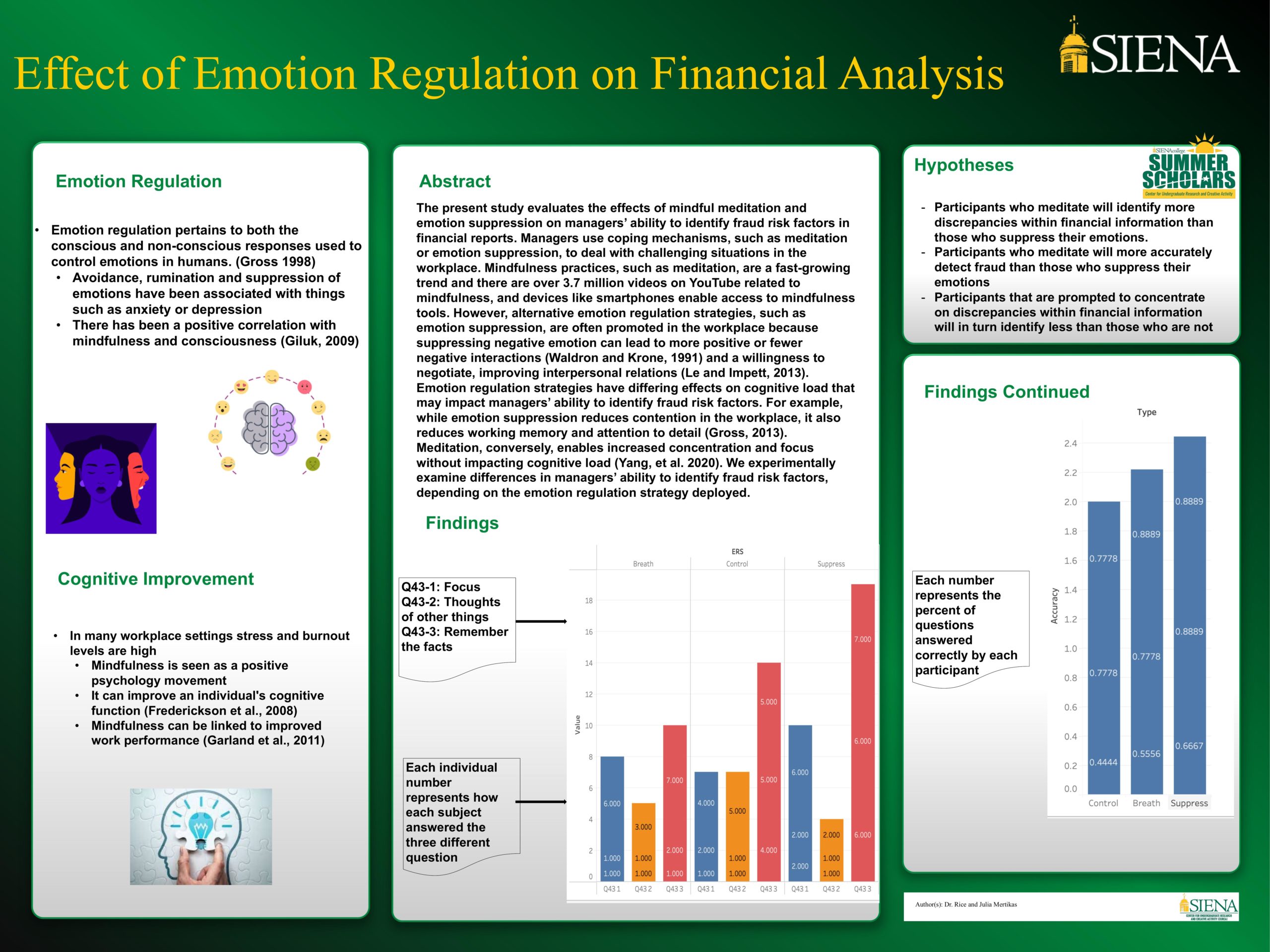
The present study evaluates the effects of mindful meditation and emotion suppression on managers’ ability to identify fraud risk factors in financial reports. Managers use coping mechanisms, such as meditation or emotion suppression, to deal with challenging situations in the workplace. Mindfulness practices, such as meditation, are a fast-growing trend and there are over 3.7 million videos on YouTube related to mindfulness, and devices like smartphones enable access to mindfulness tools. However, alternative emotion regulation strategies, such as emotion suppression, are often promoted in the workplace because suppressing negative emotion can lead to more positive or fewer negative interactions (Waldron and Krone, 1991) and a willingness to negotiate, improving interpersonal relations (Le and Impett, 2013). Emotion regulation strategies have differing effects on cognitive load that may impact managers’ ability to identify fraud risk factors. For example, while emotion suppression reduces contention in the workplace, it also reduces working memory and attention to detail (Gross, 2013). Meditation, conversely, enables increased concentration and focus without impacting cognitive load (Yang, et al. 2020). We experimentally examine differences in managers’ ability to identify fraud risk factors, depending on the emotion regulation strategy deployed.
Title
The Effect of Emotion Regulation of Financial Analysis
Faculty Advisor
Dr. Marie Rice
Course
Summer Research
Presentation Type
Location
Table 22